When I attended my first Scout leader training, I remember looking at these "scout nerds" with a bazillion knots on their uniforms and an overt reverence for the program, and I thought, "These guys are nuts." I had no intention of ever becoming like that (or putting more than the minimum required into the calling, sorry to say).
Fast forward to only a few weeks ago. We had a day full of Scouting events, going from one to the next. I left the last one to attend a baby shower - it happened to be our committee chair/ward Primary presidency representative. I was so tired at that point, I didn't bother changing out of my uniform for the shower. Her comment was, "I wouldn't recognize you without it."
Ha ha. She sees me every Sunday in Primary, but I knew what she meant. I know I project that same "scout nerd" image to everyone I work with. I do it on purpose, because I want to set the bar as high as possible. That way when people only reach halfway, they are still reaching higher than they would otherwise.
I have found that in many cases, this works well. Often enthusiasm begets enthusiasm, and a few choice people end up reaching even higher than hoped. Some people, however, seem to dig their heels in and refuse to budge no matter what.
I have even seen/heard derogatory remarks referring to LDS Scouters that are "too into Scouting." Phrases like, "Irving Scouter," and, "church of Scouting," have been tossed around, in a not-so-admiring way. "I like Scouting, but not like that..."
It makes me wonder whether some people might be afraid that if they become too into Scouting, that will somehow degrade the rest of who they are. It almost seems as if becoming too involved in Scouting will make you less of a Church member or taking the training will have a negative effect on your testimony.
I am sure this is related to the idea that the Church is "out-sourcing" its activity program for young men and that Scouting is not really a Church program.
What do you think? Have you ever noticed this attitude? Is there any way to lovingly convince people that you can love Scouting and the gospel both (aside from pointing to President Monson), that the two go hand-in-hand, and that Scouting is all about building testimonies?
(I understand this may be a sore subject for some readers. I hope we can have an open and thoughtful discussion.)

Sunday, May 20, 2012

Wednesday, May 16, 2012
Faith in God by Month (Jun-Aug)
Here is another set of three months' worth of suggestions for working on Faith in God, relating to that month's character connection and/or theme. Most of these can easily be fit into various requirements the boys are working on anyway. Check their books to see how you can fit them in. You can find the first list of ideas (Mar-May) here.
Remember, many of the requirements will need to be completed at home, but you can use den meetings to discuss them with the boys and get them started working towards some things.
Remember, many of the requirements will need to be completed at home, but you can use den meetings to discuss them with the boys and get them started working towards some things.
June: Perseverance, Head West
Young Man
Prepare a pedigree chart with your name
and your parents' and grandparents' names. Prepare a family group
record for your family and share a family story. Discuss how
performing temple work blesses families. (square knot requirement)
The “Head West” theme invokes images of pioneers. While the boys
work on their pedigree chart, you could discuss the meaning of the
word “pioneer” and the many ways a person could be a pioneer. Ask
the boys to find out interesting stories about “pioneers” in
their families that they can share (don't forget to tell the parents
yourself as well). Have an activity where you roast marshmallows
around a campfire, and everyone takes turns telling family stories
(Webelos Outdoorsman requirement 2; Bears requirement 9g). If it's
not feasible to have a real fire, make a pretend one instead. (Bring
marshmallows anyway.) Don't forget to work on the Heritages belt loop
at the same time. This also fits with Bears achievement 8.
Read D&C 88:118. Discuss what it means to "seek learning, even by study and also by faith." Improve your personal study habits by doing such things as learning how to choose and read good books or being prepared for school each day.
Learning takes perseverance, and it is the one thing we take with us after we die. School is out for the summer, but you can help the boys think of some goals they can set for themselves for the next school year, or you can encourage them to participate in your local library's summer reading program.
Plan and complete your own activity that will help you develop your talents.
Developing talents definitely requires perseverance. Talk to the boys about what talents each of them is working on (learning to play the piano, participating in a sport?), and discuss what goals they have or help them set goals. You could also have someone come to your den meeting to teach the boys a new skill.
July: Courage, Cubs in Shining
Armor
Give an opening and a closing prayer in
family home evening or at Primary. Share your feelings about how
prayer protects us and helps us stay close to Heavenly Father and the
Savior. (square knot requirement)
We can always pray when we need
more courage. Sometimes it also takes courage to pray in front of
others. Review the order of prayer with the boys.
Tell a story from the Book of Mormon
that teaches about faith in Jesus Christ. Share your testimony of the
Savior (square knot requirement)
There are some fantastic stories
about courage (not to mention fighting) in the Book of Mormon. Since
the boys are studying the Book of Mormon this year, they may already
have some favorite stories they want to share. You could also role
play the story of Ammon (Alma 17-19), make war diagrams from some of
the battles (some good ones include Alma 43:16-44:20 , Alma 55:5-23,
and Alma 56:31-56), or have the boys make their own “titles of
liberty” and relate the ideas from Captain Moroni's flag (Alma
46:12) to the Declaration of Independence for Independence Day.
August: Honesty, Kids Against
Crime
Explain how taking the sacrament helps
you renew your baptismal covenant. In a family home evening, teach
others about the things we can do to remain faithful.
The very
first thing boys do when they enter Cub Scouts is learn the Cub Scout
Promise and complete the Character Connection for Honesty. Have you
ever noticed the similarities between the Cub Scout Promise and
Baptismal covenants? See this post for some ideas on discussing
similarities about what we promise as Cub Scouts and the
promises we make when we are baptized. One of the main things we
promise is to keep the commandments, which includes being honest.
Brainstorm with the boys ways that we can keep our covenants as well
as the Cub Scout Promise so that they can teach their families in
Family Home Evening.
Write a poem, story or short play that
teaches a principle of the gospel or is about Heavenly Father's
creations.
Have the boys pair up and write short plays about
honesty. Then they can take turns performing them.
This is also a great chance to work on
the 13th Article of Faith with the boys. Here are a few
ideas:
You could give them a gathering
activity where they need to unscramble key words, like honest, true,
chaste, benevolent. Discuss what each of the words mean. Why do you
think “honest” and “true” are mentioned first? Why are they
so important?
Have the boys assemble the appropriate
puzzle from here:
Make cards with words or phrases from
the Article of Faith. Distribute them, and have the boys assemble
them in the right order. You can even make distributing the cards a
game by hiding them around the room to find or handing them out to
boys who answer a question correctly or recite the Cub Scout Promise.
Sunday, May 13, 2012
Promises and Covenants

Our oldest is is working on his Bobcat badge. The first step on the Bobcat trail is to learn the Cub Scout Promise and complete the Character Connection for Honesty.
Wanting him to understand the promise he is making, I broke it down into parts, which we discussed.
First we discussed what a promise is and how it would be dishonest to say you promise to do something that you do not intend to do. This led naturally into a discussion about covenants, specifically baptismal covenants.
(The blocks in the above picture are something I had on hand anyway - something I made for primary a while back. Obviously you don't need something like that to discuss covenants with your son, but it is a visual representation of how covenants work.)
We talked about some of the things he will be promising when he is baptized. Interestingly, each one related to other things we have discussed relative to becoming a Cub Scout. We had talked about how when he is wearing the Cub Scout uniform he is representing the Cub Scouts and needs to act accordingly so that he represents them well. I told him it is the same when he is baptized and takes on himself the name of Christ; he is representing Christ and His church. Keeping the commandments is the same as doing his duty to God. We even covenant to help other people (give goodwill).
Talking about covenants led into a discussion about Christ and the Atonement. None of us is perfect, but Christ gave us a way to repent and try again. (With the block visual, breaking part of the covenant makes the building fall down, but we can rebuild it when we repent and take the sacrament each Sunday.)
This relates back to when a Cub Scout promises to do his best. He is not promising to be perfect, just to do the best he can. We have tried to ingrain in our son the idea that everyone makes mistakes, and that's okay; that's how we learn. We are here to learn. That's why we have repentance.
Doing your best also means doing your personal best, not trying to be like someone else. This is also something Christ has asked of us. He knows each one of us. He has given us each our own, unique talents. He does not want us to compare ourselves to others.
I love how this all fits together so well. None of this was planned, it all just came together naturally.
Sunday, May 6, 2012
It's About Learning
I was talking with our Cubmaster, evaluating our most recent Pack Meeting. She observed, "The flag ceremony every month seems like the first time we've ever done it."
I had to point out that for the boy leading the ceremony, chances are it is the first time he had done it. Of course, that does not make her observations or suggestions to help less valid, but it is important to remember that the point of the boys doing these things is for them to learn.
This is the reason we make the distinction between "advancement" as a method and "personal achievement" as a goal. We have had several well-meaning parents in our pack retro-actively decide their boys had earned awards. They went through the list of belt loops and pins or Webelos Activity Badges and checked things off for the last year, "Oh, he did this and this and this..." then turned it in all at once. Now those boys have some nice awards to wear (actually, many of them are graduating Webelos, so they are not even going to wear the things), but did they get anything else out of it? They advanced, but they did not achieve. They did not learn from the experience (and I hate to think how this is going to translate into expectations in Boy Scouts).
This is why our Advancement Chair has coined the phrase, "Awards are earned intentionally, not accidentally."
In a recent post, the Volun-told Scouter pointed out:
Again, the goal here is for the boys to learn, not to have perfect organization. In Boy Scouting, leaders and parents are there to keep things safe and make suggestions. When the adults do too much, it robs the boys of the opportunity to learn.
How much the boys do on their own may come in small steps with guidance, but I think that at every point in the trail, whether you are doing a craft with Wolves or pointing Varsity Scouts toward their Eagles, you need to carefully consider how much "help" to give. Remind yourself that the point is for them to learn, not to get it done or for it to be perfect. Ask yourself whether that goal will be best accomplished by you stepping in to steer a little or by you stepping back and letting them figure things out themselves.
I had to point out that for the boy leading the ceremony, chances are it is the first time he had done it. Of course, that does not make her observations or suggestions to help less valid, but it is important to remember that the point of the boys doing these things is for them to learn.
This is the reason we make the distinction between "advancement" as a method and "personal achievement" as a goal. We have had several well-meaning parents in our pack retro-actively decide their boys had earned awards. They went through the list of belt loops and pins or Webelos Activity Badges and checked things off for the last year, "Oh, he did this and this and this..." then turned it in all at once. Now those boys have some nice awards to wear (actually, many of them are graduating Webelos, so they are not even going to wear the things), but did they get anything else out of it? They advanced, but they did not achieve. They did not learn from the experience (and I hate to think how this is going to translate into expectations in Boy Scouts).
This is why our Advancement Chair has coined the phrase, "Awards are earned intentionally, not accidentally."
In a recent post, the Volun-told Scouter pointed out:
When done right, Scouting is disorganized, messy and inefficient, because it is the Boys’ program. Adults are the facilitators, not the planners; their place is in the background as guides rather than directing from the front. Many adults find this to be anathema to their disposition – adults want efficiency, high levels of organization, etcetera. But their idea of success differs greatly from the boys'.
Again, the goal here is for the boys to learn, not to have perfect organization. In Boy Scouting, leaders and parents are there to keep things safe and make suggestions. When the adults do too much, it robs the boys of the opportunity to learn.
How much the boys do on their own may come in small steps with guidance, but I think that at every point in the trail, whether you are doing a craft with Wolves or pointing Varsity Scouts toward their Eagles, you need to carefully consider how much "help" to give. Remind yourself that the point is for them to learn, not to get it done or for it to be perfect. Ask yourself whether that goal will be best accomplished by you stepping in to steer a little or by you stepping back and letting them figure things out themselves.
Sunday, April 22, 2012
Tutorial: Book Cover

You'll need:
26" x 8 3/4" piece outer fabric. I used an all-weather canvas, because I was lucky to find it in the remnant bin. A heavy-duty canvas is great for protecting books, but be warned it will require a heavy duty needle (14 or 16). A fabric that doesn't fray much is best for this project, because we are not going to bother hemming any edges.
14" x 8 3/4" piece of fabric for lining and 6" x 8 3/4" piece for pocket. You can use pretty much any scraps you have on hand here. I used a typical quilting cotton.
1 1/2 yards 1" grosgrain ribbon
4" strip velcro

Fold pocket piece in half, right sides together. Using a 1/2" seam allowance, sew along one side. Clip corner. Turn right-side-out and press.

Line unfinished edges of pocket with unfinished edges of canvas on right side of canvas. Baste 1/4" from edge. Sew finished edge as close to the edge as you can.

On the other end (still the right side) center the soft (loop) side of the velcro about 3 1/2" from the end and sew on.

Turn the canvas over to the wrong side. You will attach the lining to the end with the velcro. I used quilt basting spray to attach it temporarily. If you prefer pins, double-stick tape or basting with the machine, do that.


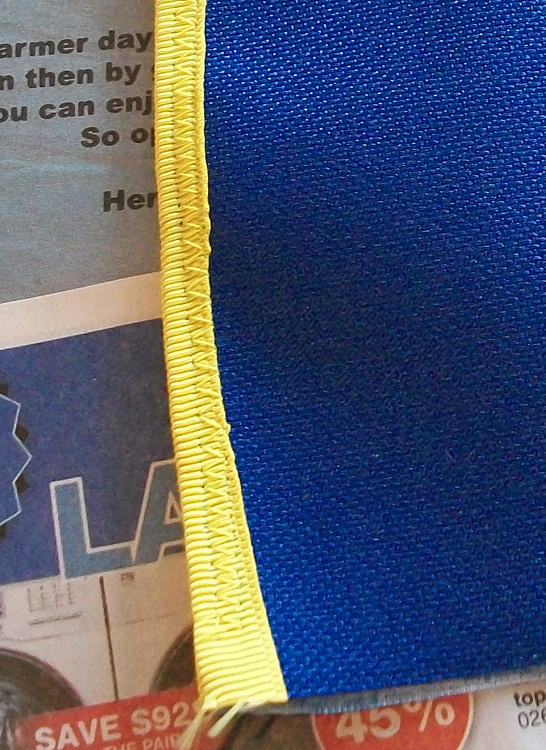
You're going to finish the short ends now with some ribbon. I have learned the best way to do this is with a zig-zag stitch so that you can be sure to catch both sides. Fold the ribbon in half over the end, like binding, and zig-zag on. Make sure to tie the ends of your zig-zag. Trim the ends of the ribbon and use Fray Check or other fray-preventing liquid.


Fold the other end in so that the total width of the cover is now about 15". Baste this down as well.

Finish the top and bottom with ribbon in the same way as above.

Center the hook side of the velcro about 3/8" from the end on the side with the pocket and sew on.

You're all finished. Now you just need to add the books. This was sized for the Webelos book, so it will be a bit loose on the smaller books, but it will still work for them. Slip the front cover in first, then slide the back cover into the pocket on back.

(This project was inspired by a post I saw a while back about making a personal progress book holder with your girls.)
Sunday, April 15, 2012
Great Resource for Cub Scouters
"We'd like you to be the den leader for the Wolves and Bears. We can't get you two-deep leadership, but you can just meet in the same room as the Webelos. Sis. Smith will be over them, and they meet at the same time."
If you have ever had this conversation, you will probably be as excited as I was when I found this website:
Even if you haven't had that conversation, you should check it out. They have many great resources for LDS Cub Scouters, but I think the real goldmine is their "LDS Delivery Method." They have set up an entire year of den plans based on the above scenario, which can be typical in wards with small programs. They have taken all the overlaps from the different levels and set things up so that, if you want to, all three dens can start out the den meeting together, then the Webelos can break off and do their own thing in a different part of the room, and Bears and Wolves can continue to work together. They have also more evenly distributed achievements and electives throughout the year, so that no matter when a boy's birthday is, he will begin working on achievements right away. They even show how to work in Faith in God and the Articles of Faith. I wish I had had this when I was a den leader.
If you have ever had this conversation, you will probably be as excited as I was when I found this website:
http://cubscout.lds-scouting.org/ldscubscouts.aspx
Even if you haven't had that conversation, you should check it out. They have many great resources for LDS Cub Scouters, but I think the real goldmine is their "LDS Delivery Method." They have set up an entire year of den plans based on the above scenario, which can be typical in wards with small programs. They have taken all the overlaps from the different levels and set things up so that, if you want to, all three dens can start out the den meeting together, then the Webelos can break off and do their own thing in a different part of the room, and Bears and Wolves can continue to work together. They have also more evenly distributed achievements and electives throughout the year, so that no matter when a boy's birthday is, he will begin working on achievements right away. They even show how to work in Faith in God and the Articles of Faith. I wish I had had this when I was a den leader.
Sunday, April 1, 2012
A little history
I knew some of this, but not all of it. I knew that the LDS Church was the BSA's first chartered organization, but I didn't know it was at the invitation of the BSA.
(This is from the brand new training aimed specifically at LDS Wolf and Bear Den Leaders):
(This is from the brand new training aimed specifically at LDS Wolf and Bear Den Leaders):
In 1875, Brigham Young organized the Young Men Mutual Improvement Association (YMMIA or MIA) to provide leisure-time activities for the young men of the Church. Later, athletics became part of the program.
As news of the organization of the Boy Scouts of England in 1907 and the Boy Scouts of America in 1910 was received by the Church leaders, the Scouting idea was investigated by the Athletic Committee of the YMMIA. On November 29, 1911, the MIA Scouts were officially recognized by the General Board of the YMMIA. The MIA Scouts, upon invitation from the BSA National Council, became a part of the Boy Scouts of America on May 21, 1913. This is the BSA’s longest formal partnership with a national chartered organization.
Subscribe to:
Posts (Atom)